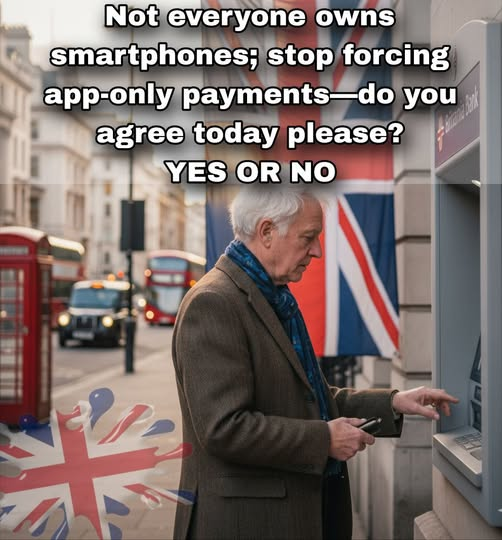
Not everyone owns smartphones — so why are businesses forcing app-only payments? The answer is simple: they shouldn’t.
In 2026, society loves to pretend that “everyone is digital now.” But that is a fantasy created by corporations, fintech companies, and convenience-driven policymakers who spend their lives glued to screens.
The truth is much harsher: millions of people are still being left behind every single day because companies are replacing choice with forced technology. Recent reporting has highlighted growing outrage over what campaigners call the “tyranny of apps,” where discounts, parking, loyalty rewards, ticketing, and even routine payments increasingly require a smartphone app just to participate.
And this is not a tiny fringe problem.
Globally, billions remain either partially offline or digitally excluded due to cost, age, literacy, poor devices, weak connectivity, or security concerns. Even among people who technically own a phone, many do not use payment apps confidently enough to rely on them for everyday transactions.
So when a store says:
“App payments only.”
“QR scan required.”
“Discount available through mobile wallet only.”
what they are really saying is:
“If you are elderly, poor, rural, visually impaired, not tech-savvy, or simply privacy-conscious — your money is less welcome.”
That is not innovation.
That is exclusion dressed up as modern convenience.
Yes, digital payments are useful. Nobody denies that. Tap-to-pay, wallets, QR systems, and online banking make life easier for millions. But easier for some does not justify impossible for others. Financial inclusion experts repeatedly warn that when economies move too fast toward digital-only systems, vulnerable users are the first to get locked out — especially seniors, low-income households, and people without stable internet access.
Think about the grandmother with a basic keypad phone.
Think about the laborer who cannot afford a $300 smartphone.
Think about the customer whose battery dies.
Think about the person who simply does not trust handing every transaction to another app harvesting data.
Why should any of these people be denied the basic right to pay?
Cash still works. Cards still work. Human-operated alternatives still work.
So why remove them?
Because app-only systems are not just about payment.
They are about data collection.
They are about forcing account sign-ups.
They are about tracking habits.
They are about reducing staff interaction.
And they are about pushing consumers into controlled ecosystems where companies know exactly what you buy, when you buy it, and how often you return.
In short:
this is corporate convenience — not public convenience.
A civilized payment system should never punish people for not owning the latest device.
Technology should expand options, not erase them.
If businesses truly care about accessibility, the rule should be simple:
Offer digital, yes.
Force digital, no.
Because the moment society decides that only smartphone users deserve seamless access to goods and services, we stop being inclusive and start becoming technologically discriminatory.
And many people are finally beginning to say enough.
Do you agree?